

Why one of KLA's signature engagement tools is a perfect way to
leverage limited resources to tackle the climate crisis
If you work in local government right now, you are doing more with less. Budgets are tight. Federal funding is unreliable. Some of you have watched good colleagues get laid off, and the people who stayed are covering two jobs.
So when someone suggests adding a Climate Ambassador program, it’s understandable to have the gut reaction of “We can't afford that right now.”
But hear us out. When money is tight and your team is short-staffed, a Climate Ambassador program is not a luxury. It's leverage.
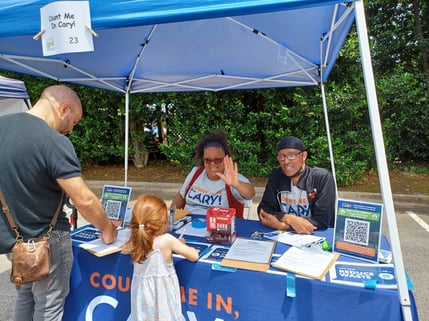
First, a quick refresher. A Climate Ambassador program is one of KLA's signature community engagement tools. We partner with trusted, community-based organizations (often ones that represent the groups your outreach usually misses) to find and train local residents who then engage their own neighbors and networks. We train them on climate science, communications, and engagement best practices. And we always pay them a living wage, calculated with the MIT Living Wage Calculator. This is paid work, not free labor dressed up as volunteering.
A force multiplier, not a line item.
Think about who a stretched two-person sustainability office can actually reach on its own. A handful of evening meetings and weekend events. The same faces every time. The usual suspects.
Now think about who four trained, paid residents can reach in that same month: in the languages their neighbors speak and , at the cookouts and church basements and Little League games your staff will never get invited to.
A small, well-run Ambassador program buys you reach you could not hire your way to, at a fraction of the cost of another full-time staffer.
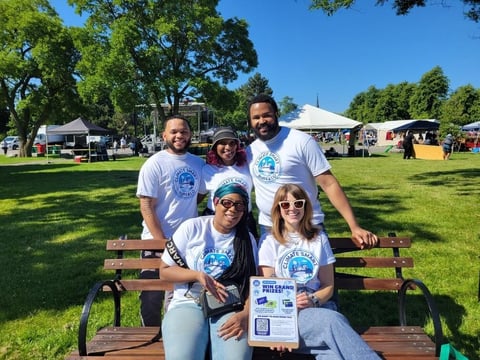
Take Buffalo, New York. The city needed to capture residents' lived experiences of climate impacts for its plan. KLA trained a team of four Ambassadors for a single weekend, the Juneteenth festival, the biggest event in the city. The Ambassadors had a clear goal: get people to take a short survey. The result was roughly 1,000 responses, more than Buffalo had ever collected. One weekend. Four people.
You do not need a big department or a deep bench to start.
Here is the honest math. A solid program runs about $5,000 per Ambassador over a few months. A scrappy but real program can launch for $5,000 to $10,000 total. You size it to your priority audiences, not your population. A town of 27,000 might start with two or three Ambassadors and add more over time.
And you rarely have to find that money in the sustainability budget alone. Communities fund Ambassadors through existing engagement budgets, grants, utility program partnerships, AmeriCorps, summer youth and rec budgets, public works, even downtown business districts and corporate sponsors.
From planning to actually getting it done
Here is the shift we most want you to make. Most communities use Ambassadors to write the climate action plan: gather input, host the open houses, fill out the survey, then thank everyone and send them home.
That is a mistake. The plan was never the point.
The hardest part of climate work is not the planning. It's the doing. Getting residents to swap the boiler for a heat pump, sign up for community solar, show up to the resilience hub. That is exactly the work Ambassadors are built for, and it is exactly when most programs disband them.
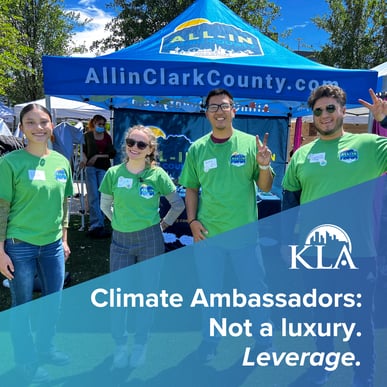
Clark County, Nevada shows the better path. KLA helped stand up an Ambassador program there during the planning phase, where two online influencer-Ambassadors alone helped drive more than 6,000 survey responses. But the real story is what happened next. In 2024 – after the All-In Clark County Sustainability and Climate Action Plan was adopted --, the County reignited the program for plan implementation. This time more than 100 residents applied. Fifteen Ambassadors have held steady ever since, carrying myth-busting toolkits, an online education series, and a real training program into a county so big that some Ambassadors drive 90 minutes each way and never cross the county line.
In fairness, Clark County is large and well-resourced. Not every community starts there. But every community can decide that its Ambassadors do not go home the day the plan gets adopted.
We’ve also worked with Cary, North Carolina; Albany, New York; Indianapolis, Indiana; Portland, Maine; and New Bedford, Beverly and Salem, Massachusetts to execute successful Climate Ambassador programs.
Why this works
Underneath all of it is trust. About 67% of Americans trust their local government. Only 32% trust Congress. Your residents are far more likely to act on the word of a neighbor than a press release. Ambassadors are how you turn that trust into action, and how you finally reach beyond the choir.
The bottom line
Climate Ambassadors are one of the clearest ways we know to do more with less, and to move a plan off the shelf and into the neighborhood. It is the same principle behind ActionReady, our program for getting communities from planning to measurable results.
If your budget is tighter than it has ever been and your plan is sitting there waiting to become real, this is the conversation to have. Reach out, and let's talk about what a right-sized Ambassador program could look like in your community.
We'll keep sharing what we learn, and book some time to talk with us about an ambassador initiative in your community. We've written about Climate Ambassadors before:
Translating Trust Into Climate Action
Beyond a Buzzword: Why Equity is a KLA Core Value
Four Steps to Add Street Teams to Your Equity and Community Engagement Efforts