

When we raise the dignity of our public discourse,
we raise our ability to solve real problems like the climate crisis
As seen in Kim's recent LinkedIn post.
In January 2026, I heard Tim Shriver speak about the Dignity Index at the Massachusetts Municipal Association conference in Boston. I left genuinely energized, and I said publicly that I’d come back for a deeper dive.
I’m coming back to it now for two reasons:
- First, because many of us who work with or in local government are feeling the strain of public discourse. In a recent LinkedIn post, I shared that I’m “done… just done” with the contempt that can dominate public life. That post resonated widely not because people are fragile, but because people are tired.
- Second, because the Dignity Index team has now released a major new research product: the nation’s first-ever Dignity Barometer, conducted in February 2026, which puts numbers to what many of us experience every day.
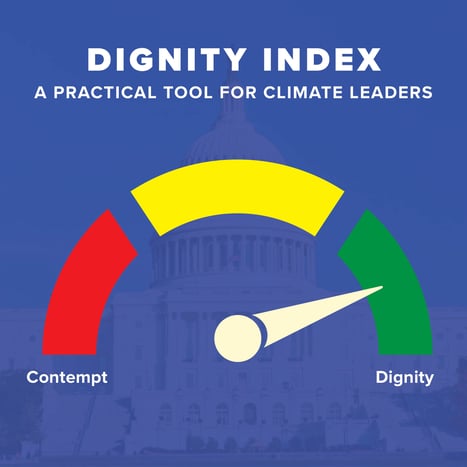
What the Dignity Index Is
The Dignity Index is an eight-point scale that helps us measure what we do when we disagree, ranging from contempt to dignity. Lower scores (1–4) reflect language rooted in contempt and division; higher scores (5–8) reflect language grounded in dignity and openness.
What I appreciate most is the focus. It looks at the speech, not the speaker. This helps us step away from identity-based triggers and toward something we can actually influence: how we show up in the conversation.
That lines up closely with a core dignity principle. Treating people with dignity means seeing ourselves in them, while treating people with contempt means seeing ourselves above them.
Why this Matters for Climate Leaders in Local Government
Climate work isn’t only technical. It’s civic.
Decarbonizing buildings. Planning for heat. Updating infrastructure. Managing flood risk. These decisions live at the intersection of money, values, and lived experience. Even when the science is clear, the conversation can get messy fast.
And here’s the hard truth that the dignity lens makes very visible: contempt creates enemies for the causes we care about.
That’s not just a moral statement. It’s a strategy statement.
If we want communities to adopt solutions that reduce emissions and protect people from heat, storms, and flooding, then we need public meetings and public discourse that can actually sustain… well… public problem solving.
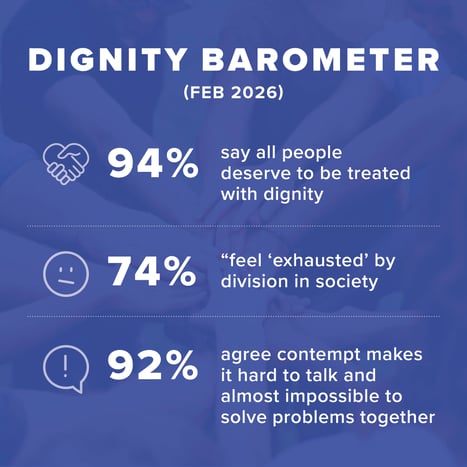
The Dignity Barometer is a Wake-Up Call
The February 2026 Dignity Barometer findings are striking:
- 78% of Americans are dissatisfied with the way people treat each other, and 77% say it’s getting worse.
- 74% say they are exhausted by the level of division in society today.
- Concern about political divisions is essentially as high as concern about the cost of living, and large majorities also see “people not treating others with dignity” and “people treating others with contempt” as major problems.
- Nearly universal agreement: all people deserve to be treated with dignity (94%).
- And one of the most relevant findings for local government: 92% agree that contempt makes it hard to talk and almost impossible to solve problems together.
Let’s apply that to climate work. If contempt is the water we’re swimming in, we will struggle to pass budgets, build coalitions, or sustain long-term implementation even when we all want our community to be safer and more affordable.
Local Government Leaders Must Model the Culture they Want
This isn’t abstract. Local government leaders have a unique role because we operate closer to the ground and in the places where people still have shared identity: schools, neighborhoods, public safety, public works, community health.
And your public meetings? They are culture-making machines.
The Dignity Index emphasizes something I think local leaders already know in their bones: safety is foundational. If we want candidate conversation and problem solving, people need to feel safe from humiliation and retaliation when they speak up.
A Simple Playbook to Use the Dignity Index in Local Climate Work
Here are five practical ways climate leaders can leverage the Dignity Index without turning meetings into therapy sessions:
- Name the standard (before conflict begins)
Open climate-related meetings with a simple norm:
“We’re here to solve problems. We can disagree. We will not use contempt.”
The index gives you a neutral frame of talking about how we disagree, not whether we disagree. - Protect “safety” as an operational requirement
Treat psychological safety like you treat physical safety. If a meeting becomes demeaning, you wouldn’t call that “public engagement.” You’d call it a breakdown. Safety enables candid communication, whereas fear shuts it down.
- Train your team on a few “dignity phrases”
You don’t need a 2-hour workshop to set this in motion. You can start with 6–10 phrases people can actually use when things get hot, like:- “Can you tell me more about that?”
- “I want to hear what you think.”
- “Let’s figure out what we disagree on because it can’t be everything.”
- Use the scale as a quick “temperature check”
After a contentious meeting, debrief with staff to discuss “Where were we on the 1–8 scale?”
Then ask “What would a one-point improvement look like next time?”
That’s implementable. And it’s how cultures change.
- Connect dignity to outcomes
The dignity principles are clear that contempt is corrosive, makes both sides angrier, and creates enemies for our causes. Spotlighting dignity and contempt reduces contempt’s power.
This is outcomes work.
A Closing Thought for Climate Leaders
We are being asked to do big things in our quest to reduce emissions, protect people from heat and flooding, modernize infrastructure, stabilize costs, and help residents navigate change.
We cannot do that work well in an ecosystem of contempt.
The Dignity Index isn’t a silver bullet, but it’s increasingly rare to find a practical tool that helps us protect relationships, improve meetings, and strengthen the civic muscle we need to deliver results.
The KLA Team will keep sharing what we learn as we apply this lens in real-world climate conversations. We see climate action as core governance, and governance requires a culture that can solve problems together.
If you’re as intrigued as we are, check out this National League of Cities CitiesSpeak podcast about the Dignity Index or tap into the Dignity Index resources.